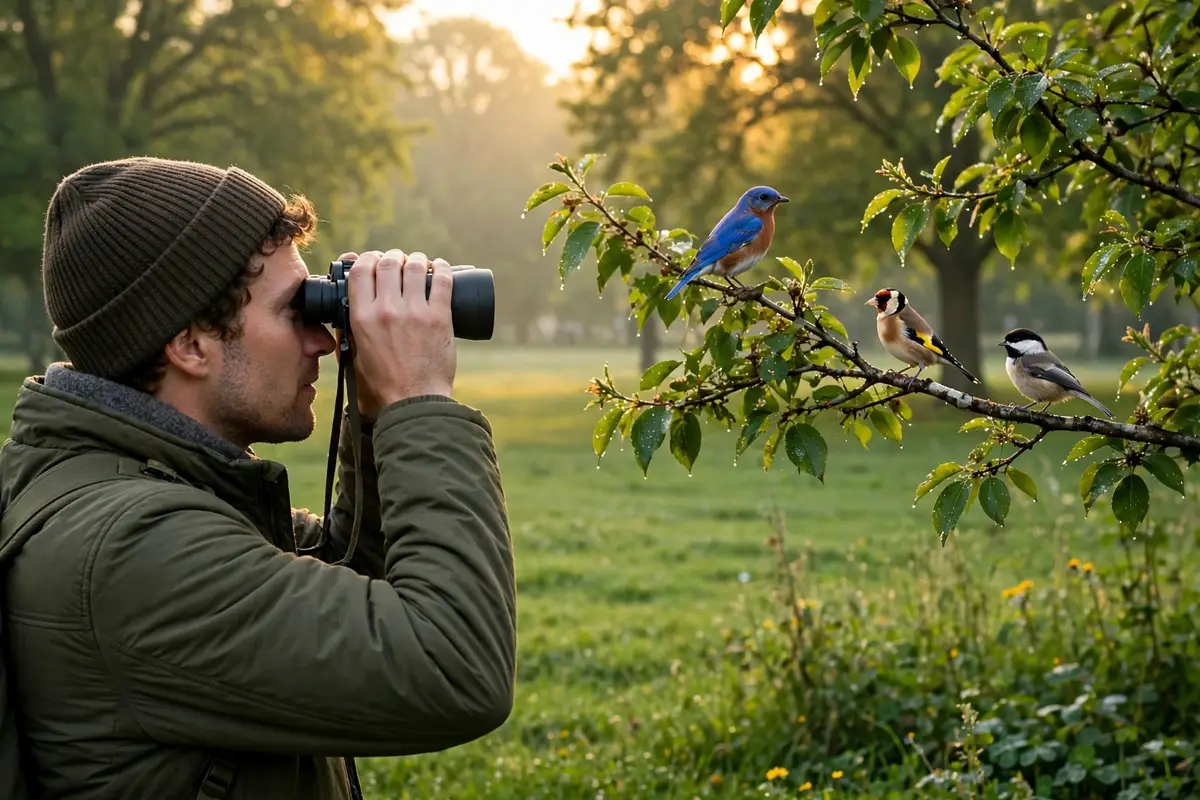

You do not need to travel to a remote wilderness to feel your shoulders drop and your breathing slow down. Forest bathing — the practice of spending slow, unhurried time among trees — asks only that you show up, put your phone away, and let the woodland do what it has always done. Known in Japan as shinrin-yoku, it is less a form of exercise than a form of attention: walking gently, pausing often, and noticing the forest with all of your senses.
This guide explains what forest bathing is, what the research suggests it can do for your health, and how to practise it in any woodland, park or tree-lined path near your home.
What Forest Bathing Actually Is
Forest bathing began in Japan in the 1980s, when the national forestry agency promoted it as a gentle antidote to the stress of modern working life. Despite the name, there is no water involved and nothing to buy. You are “bathing” in the atmosphere of the forest: the light through the canopy, the scent of soil and leaves, the sound of wind moving at different heights.
The crucial difference from an ordinary hike is pace and purpose. A hike has a destination and usually a step count. Forest bathing has neither. Two hours spent covering less than a kilometre is entirely normal — the distance is irrelevant; the noticing is the activity. If you arrive back at the car park feeling like you have been somewhere far away, you have done it right.
What the Research Suggests
Studies of shinrin-yoku, mostly from Japan and South Korea, report a consistent pattern of short-term effects: lower blood pressure and heart rate after woodland walks compared with city walks, reduced levels of the stress hormone cortisol, and improved mood scores. Some research has also found increased activity of natural killer cells — part of the immune system — lasting for days after a forest trip, an effect researchers link partly to phytoncides, the airborne compounds trees release to protect themselves.
None of this makes forest bathing a medicine, and it should never replace proper care for any condition. But as a low-cost, side-effect-free way to unwind, the evidence is unusually coherent: slow time in green, tree-filled places reliably leaves people calmer than the same time spent in built environments. It pairs naturally with other gentle outdoor habits — our beginner’s guide to starting birdwatching rewards exactly the same slow, attentive way of being outside.
How to Practise Forest Bathing, Step by Step
Choose your place. Anywhere with mature trees works: a woodland, a large park, a tree-lined cemetery, even a quiet botanical garden. What matters is canopy overhead and relative quiet. Coniferous woods have the strongest scent; mixed broadleaf woods change beautifully with the seasons.
Leave the goals behind. Switch your phone off or to silent and put it in your bag. No headphones, no podcast, no step target. If you wear a fitness tracker, ignore it for once — this is the rare outing where the numbers are not the point.
Walk slower than feels natural. Halve your usual pace, then halve it again. Stop whenever something catches your attention. Forest bathing guides sometimes cover a few hundred metres in two hours; let that permission to dawdle sink in.
Rotate through your senses. Spend a few minutes on each: the layers of green and the movement of light; the sounds near and far; the smell of the path after rain; the texture of bark and leaf; the taste of the air itself. When your mind wanders to your inbox, return it gently to whichever sense you are on.
Sit for a while. Find a log, a stone or a patch of dry ground and simply sit for fifteen or twenty minutes. A “sit spot” is where the forest reveals itself — birds resume their business, insects cross the path, and your own breathing settles to match the place.
Close gently. Some practitioners finish with tea or a snack at the forest edge, a small ritual that marks the return to ordinary time. Even without one, walk back slowly rather than striding to the car; the calm you are carrying is the whole harvest.
Forest Bathing With Children and Beginners
Children take to forest bathing instinctively once the pace is theirs: let them lead, collect textures (fallen leaves, cones, smooth stones), and build small dens. Keep sessions shorter — forty minutes of genuine wandering beats two hours of being marched. Beginners who feel self-conscious should remember that there is nothing to perform; nobody can tell a forest bather from a person on a very slow walk, and that is rather the point.
If structured learning helps you settle, the same focus techniques transfer: the concentration habits in our guide to study tips that help you learn more in less time — short sessions, single-tasking, removing the phone — work as well under trees as at a desk.
Making It a Habit
Like most restorative practices, forest bathing rewards regularity over intensity. A weekly hour in the same wood becomes a quiet education: you notice the first buds, the week the birdsong peaks, the exact tree where the light lands in autumn. Many people find it becomes the anchor of their week — a standing appointment with somewhere that asks nothing of them.
It also tends to change how people treat green spaces. Time spent slowly in a wood makes the case for protecting it more eloquently than any campaign; readers who feel that pull often enjoy our explainer on how recycling works and our beginner’s guide to composting at home — small household habits that come from the same place of paying attention.
The Bottom Line
Forest bathing is the simplest health practice on earth: go where the trees are, slow down, and pay attention. No kit, no cost, no skill — just time, given properly. Start with one unhurried hour in your nearest woodland this week, phone off and senses on, and notice how different the world feels on the walk home.
Keep Reading
If you found this useful, these related guides from our team go deeper on nearby topics:
- How to Start Birdwatching: A Beginner’s Guide to Enjoying Birds Anywhere
- How Recycling Works: What Really Happens to Your Waste After Collection
- How to Start Composting at Home: A Beginner’s Guide
- Study Tips for Students: How to Learn More in Less Time
- Best Nature Documentaries to Watch: 9 Films That Bring the Wild Home