
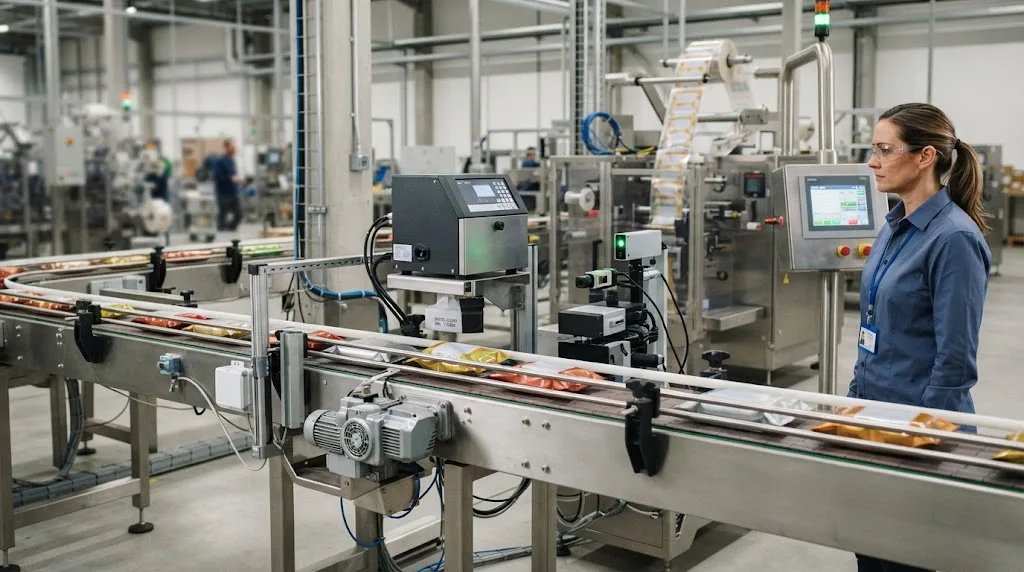
PT Printpack Technology operates in the industrial coding, marking, packaging, automation, and product-inspection space, helping manufacturers address practical production requirements such as product identification, date coding, packaging, and quality inspection. Its current portfolio includes technologies such as Thermal Inkjet, Continuous Inkjet, Thermal Transfer Overprinting, and laser printing.
Modern packaging operations increasingly depend on accurate coding, consistent production, reliable packaging equipment, and inspection systems that fit into existing manufacturing workflows. Rather than treating these functions as isolated processes, an integrated approach can connect several stages of production and help manufacturers build more organized production lines.
This guide explores PT Printpack Technology, the technologies it offers, how industrial coding works, where packaging automation fits into manufacturing, and what businesses should consider before selecting equipment.
What Is PT Printpack Technology?
PT Printpack Technology is an industrial technology supplier focused on coding, marking, packaging, and product-inspection solutions. Its official company information describes integrated solutions for coding, expiration-date printing, packaging, and inspection across multiple industrial sectors.
The company’s current portfolio is aimed at manufacturers that need to apply variable information to products or packaging while also managing broader packaging and production requirements.
This makes PT Printpack Technology relevant to businesses looking for more than a standalone printer. Depending on the application, a production line may require coding equipment, packaging machinery, consumables, inspection systems, and technical support working together.
For a broader look at technology-driven business operations, readers can also explore Husdow technology and business efficiency.
Why Industrial Coding Matters in Manufacturing
Industrial coding is an important part of modern manufacturing because products frequently need information such as production dates, expiration dates, batch numbers, serial numbers, barcodes, or QR codes.
Accurate marking can support product identification and traceability throughout manufacturing, storage, logistics, and distribution. The specific information required depends on the product and the manufacturer’s operational or regulatory needs.
PT Printpack Technology’s own industrial coding material explains how coding and marking technologies can support product identification, packaging labels, expiration dates, and integration with production lines.
Businesses researching the wider relationship between technology and commercial operations may also find technology and business brokerage useful as a broader technology-business comparison.
Thermal Inkjet Technology
Thermal Inkjet, or TIJ, is one of the printing technologies offered by PT Printpack Technology. TIJ uses controlled heating inside the printhead to create small ink droplets that are ejected onto a suitable surface.
The technology can be useful for applications requiring clear, high-resolution variable information. PT Printpack Technology describes TIJ as suitable for applications such as date, batch, and code marking, particularly where print quality and ease of operation are important.
TIJ can be relevant to industries such as food and beverage, pharmaceuticals, consumer products, and other manufacturing environments where product information needs to be printed clearly.
Manufacturers interested in the technical operation of the technology can review the detailed explanation of how Thermal Inkjet machines work.
Continuous Inkjet Printing
Continuous Inkjet, commonly called CIJ, is another industrial coding technology in the PT Printpack Technology portfolio.
CIJ systems continuously generate ink droplets and direct selected droplets toward the product surface. This approach makes CIJ particularly relevant to continuous production environments where products move through a production line at speed.
Depending on the equipment and application, CIJ can be used for coding products made from materials such as plastic, glass, metal, cartons, bottles, and flexible packaging.
The technology can be particularly useful when manufacturers need reliable coding across moving products and continuous production workflows.
For a more detailed comparison, see the guide explaining TIJ versus CIJ printers.
Thermal Transfer Overprinting
Thermal Transfer Overprinting, or TTO, is another technology offered through PT Printpack Technology’s product portfolio.
TTO is commonly associated with variable information printing on suitable flexible packaging materials. It can be used for information such as dates, batch details, codes, and other variable production data.
The technology is particularly relevant when printing needs to become part of an automated packaging workflow rather than being handled as a separate manual process.
PT Printpack Technology maintains a dedicated range of Thermal Transfer Overprinting equipment, giving manufacturers another option when evaluating packaging-printing requirements.
Laser Printing and Permanent Marking
Laser marking provides another approach to industrial identification. Instead of relying on conventional ink printing, a laser system creates a mark on a compatible material through a controlled laser process.
Laser systems can be attractive for applications where durable marking, reduced dependence on ink consumables, or specific material requirements are important.
However, laser marking is not automatically the best solution for every production line. Material characteristics, desired mark quality, production speed, installation environment, and budget all need to be considered.
PT Printpack Technology includes laser printing alongside TIJ, CIJ, and TTO technologies within its broader coding and marking portfolio.
Packaging Automation and Production Lines
Printing is only one part of packaging. Depending on the manufacturing environment, a packaging line may also involve carton forming, sealing, bag insertion, labeling, conveying, inspection, and other automated processes.
Automation can connect these activities so that products move through the line with less manual intervention. The right level of automation depends on production volume, product type, packaging format, available floor space, labor requirements, and existing machinery.
PT Printpack Technology’s current portfolio includes packaging machinery as well as coding and marking equipment, allowing businesses to consider several production requirements within the same technology ecosystem.
Its broader equipment portfolio includes categories such as Continuous Inkjet equipment and other printing and packaging machinery.
Product Inspection and Quality Control
Product inspection provides another important layer of manufacturing control. Coding systems can print the required information, but manufacturers may also need inspection technology to identify unwanted conditions before products continue through the production process.
PT Printpack Technology describes product inspection as part of its integrated offering and highlights metal-detection systems among its inspection solutions.
Inspection requirements vary significantly by industry. A food manufacturer, pharmaceutical producer, cosmetics company, and industrial manufacturer may all have different quality-control priorities.
For that reason, inspection equipment should be selected according to the actual product, packaging, production environment, and quality requirements.
Industries That Can Use Coding and Packaging Technology
PT Printpack Technology states that it serves several industrial sectors, including food, beverage, pharmaceutical, cosmetic, chemical, and general manufacturing applications.
Each industry can have different coding and packaging requirements.
- Food: Date and batch information can be important for product identification and distribution.
- Beverage: Bottles, cans, cartons, and other containers may require variable coding.
- Pharmaceutical: Product identification and packaging information can be particularly important.
- Cosmetics: Bottles, tubes, cartons, and other packaging formats may require coding and labeling.
- Chemicals: Product information and identification can be applied to different packaging surfaces.
- Manufacturing: Components and finished goods may require serial numbers, production codes, or other markings.
Businesses involved in wider industrial operations can also explore NatureUpdate’s cargo and industrial investment discussion for broader context around manufacturing and distribution activity.
Choosing Between TIJ, CIJ, TTO and Laser
Selecting a coding technology should begin with the production requirement rather than the machine name.
A manufacturer should consider:
- The material or substrate being printed.
- The required production speed.
- The size and resolution of the printed information.
- Whether the production line operates continuously.
- The durability required from the printed mark.
- The availability and cost of consumables.
- Maintenance requirements.
- Integration with existing machinery.
- The available installation environment.
- The total cost of ownership.
For example, TIJ can be attractive where high-resolution printing and straightforward cartridge replacement are important, while CIJ may be more appropriate for continuous high-speed production. TTO has a strong connection with flexible packaging applications, while laser can be useful where permanent marking is required on suitable materials.
There is no universal winner. The correct choice depends on the production line.
Why Integration Matters
A new printer can only provide its full value when it works effectively with the rest of the production process.
Integration may involve conveyors, sensors, packaging machinery, inspection systems, software, product triggers, and production controls. A coding machine that cannot reliably communicate with the surrounding workflow may create more operational problems than it solves.
Businesses should therefore evaluate the complete production line before choosing equipment.
This broader approach is similar to the technology-business relationship discussed in Docan Technology and modern technology experiences.
Maintenance and Technical Support
Industrial equipment requires more than an initial installation. Operators may need training, maintenance guidance, replacement parts, consumables, troubleshooting assistance, and technical support throughout the equipment’s working life.
PT Printpack Technology states that it provides installation training, after-sales support, and spare parts and consumables as part of its service offering.
When comparing suppliers, businesses should ask how technical support works after installation. Availability of replacement parts and consumables can be particularly important when production equipment is operationally critical.
Manufacturers can also benefit from understanding how technology suppliers approach long-term support, an issue that is relevant across the wider technology industry.
How Technology Can Improve Packaging Workflows
Automation does not automatically make a production line better. Its value comes from solving a specific operational problem.
For example, a manufacturer may want to reduce manual coding, improve consistency, increase production capacity, simplify packaging operations, or add inspection capabilities. The technology should then be selected around that objective.
A useful implementation process can include:
- Documenting the existing production workflow.
- Identifying the main bottlenecks.
- Defining coding and packaging requirements.
- Testing suitable equipment with the actual product and packaging materials.
- Planning equipment integration.
- Training operators.
- Establishing maintenance procedures.
- Monitoring performance after installation.
This approach is generally more useful than purchasing equipment simply because it has more features.
Packaging, Logistics and Distribution
Packaging technology also connects directly with logistics. Once a product leaves the production line, its packaging needs to survive handling, storage, transportation, and distribution.
Clear identification can help products remain distinguishable throughout the supply chain, while appropriate packaging can help protect goods during movement.
NatureUpdate also covers the broader supply-chain environment through articles such as RT-T Logistics and supply-chain operations, SSB Logistics and shipping solutions, and Blue Jay Logistics and logistics technology.
These topics demonstrate why packaging cannot always be considered separately from the wider movement of products through the supply chain.
What Businesses Should Evaluate Before Buying
Before investing in industrial coding or packaging equipment, decision-makers should establish the exact operational requirement.
Useful questions include:
- What products will be coded?
- What packaging materials will be used?
- What information must be printed?
- How fast does the production line operate?
- How frequently will the information change?
- How durable must the printed information be?
- How much operator involvement is required?
- What maintenance will the system need?
- What consumables will be required?
- How will the system integrate with current equipment?
- What technical support is available after installation?
Answering these questions before requesting quotations can make supplier comparisons considerably more useful.
The Role of Software and Data
Modern coding systems can also be connected to digital production processes. Variable information may need to change from one product to the next, which makes reliable data handling increasingly important.
Depending on the production environment, coding equipment may interact with databases, production software, sensors, product triggers, or other control systems.
The goal is not simply to print faster. It is to ensure that the right information reaches the right product at the right stage of production.
PT Printpack Technology and Modern Manufacturing
The broader direction of industrial packaging is toward better integration between coding, packaging, inspection, and production management.
PT Printpack Technology’s current portfolio reflects this direction by combining coding and marking technologies with packaging equipment and inspection solutions.
Its official website also maintains educational material covering topics such as why modern factories are switching to industrial inkjet printers, providing additional technical context for manufacturers comparing manual and automated coding approaches.
The wider technology landscape covered by NatureUpdate includes topics such as Husdow Technology Co. Limited, showing how different technology businesses approach modern industrial and commercial challenges.
Frequently Asked Questions
What does PT Printpack Technology do?
PT Printpack Technology provides industrial coding, marking, packaging, automation, and product-inspection solutions for manufacturing applications.
What printing technologies does PT Printpack Technology offer?
Its current website highlights Thermal Inkjet, Continuous Inkjet, Thermal Transfer Overprinting, and laser printing among its coding and marking technologies.
What is industrial coding used for?
Industrial coding is commonly used to apply information such as production dates, expiration dates, batch numbers, barcodes, QR codes, serial numbers, and other product-identification information.
What is the difference between TIJ and CIJ?
TIJ uses cartridge-based thermal inkjet technology, while CIJ continuously generates and directs ink droplets. TIJ can be attractive for high-resolution applications, while CIJ is commonly associated with continuous high-speed production.
What is TTO used for?
Thermal Transfer Overprinting is commonly used for variable information printing on suitable flexible packaging materials.
Is laser printing better than inkjet?
Neither technology is universally better. The right choice depends on the material, required mark, production speed, durability requirements, operating environment, and total cost of ownership.
Does PT Printpack Technology provide technical support?
The company’s current website states that it provides installation training, after-sales support, and spare parts and consumables.
Which industries can use these technologies?
PT Printpack Technology identifies food, beverage, pharmaceutical, cosmetic, chemical, and manufacturing sectors among the industries it serves.
Conclusion
PT Printpack Technology sits at the intersection of industrial coding, packaging, automation, and inspection. Its current portfolio gives manufacturers several options for applying variable information, automating packaging processes, and adding inspection capabilities to production environments.
The most important consideration is not simply choosing the newest machine. Businesses should match the technology to their substrate, production speed, coding requirements, packaging format, maintenance needs, and integration plans.
TIJ, CIJ, TTO, and laser systems each have different strengths. When the technology is selected around the actual production requirement and supported by appropriate integration and technical support, it can become a practical part of a modern manufacturing workflow.
For manufacturers exploring packaging modernization, PT Printpack Technology’s official product and technical resources provide a useful starting point for comparing available technologies and determining which approach best fits a particular production line.