
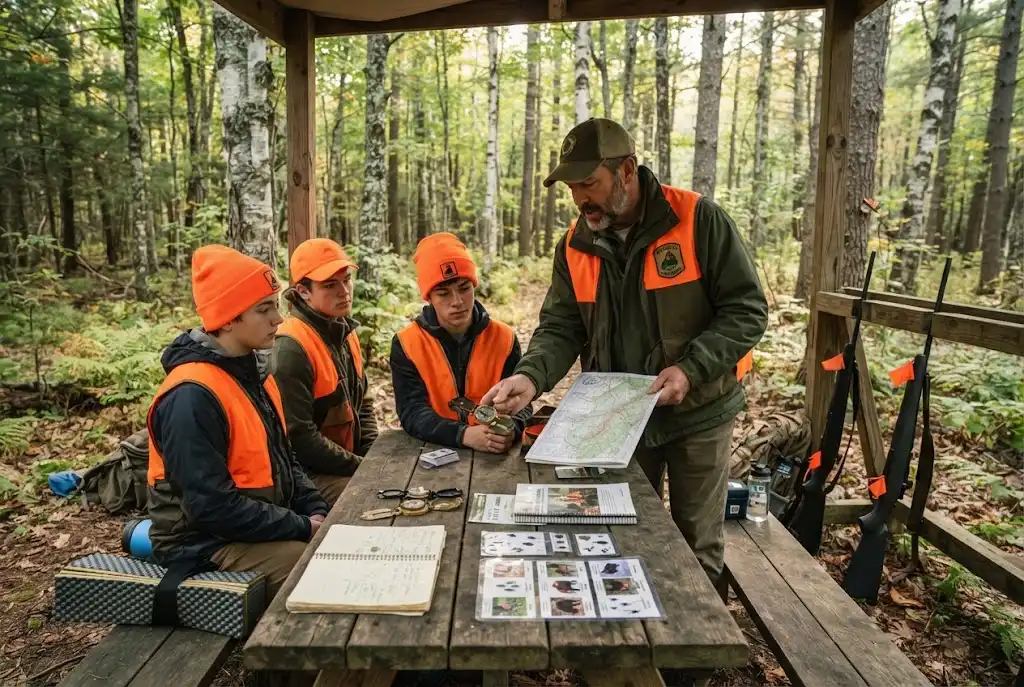
New Hampshire’s hunter education system is designed to prepare participants for real-world situations in the field. Training can address firearm and archery safety, outdoor safety and survival, state hunting regulations, and responsible behavior around wildlife. The goal is not simply to pass a test, but to develop the knowledge and judgment needed for safer hunting.
What Is the NH Hunter Education Course?
The New Hampshire hunter education course is a state-recognized training program for people learning how to hunt safely and responsibly. It combines knowledge of hunting practices with safety, legal, and conservation considerations.
New Hampshire requires applicants who do not have qualifying prior hunting credentials to provide proof of hunter education or equivalent previous hunting experience when obtaining a hunting license. State law also recognizes qualifying hunter education completed in another state, province, or country.
The course is therefore more than an introduction to hunting equipment. It provides a foundation for understanding how a hunter should behave in the field and how hunting fits within New Hampshire’s wildlife-management framework.
What You Learn in a New Hampshire Hunter Education Course
A comprehensive hunter education program covers several areas that are important for new hunters.
Firearm and Archery Safety
Safety around firearms and archery equipment is a central part of hunter education. Participants learn why equipment must be handled carefully, how safe practices reduce risk, and how hunters should conduct themselves around other people in the field.
New Hampshire’s hunter education information specifically identifies firearms and archery safety and handling among the subjects covered by the program.
Outdoor Safety and Survival
Hunting takes place in outdoor environments where weather, terrain, navigation, and unexpected circumstances can affect a trip. Hunter education introduces participants to outdoor safety and survival considerations so they can make better decisions away from developed areas.
Basic preparation can include understanding your surroundings, carrying appropriate equipment, planning a route, monitoring conditions, and knowing what to do if something does not go according to plan.
New Hampshire Hunting Laws
Knowing the rules is an essential part of becoming a responsible hunter. Hunter education introduces participants to New Hampshire hunting laws and the responsibilities associated with holding a hunting license.
Regulations can change, so completing an education course should not be treated as a substitute for checking current hunting rules before each season. Hunters should consult current New Hampshire Fish and Game information for licensing, seasons, species-specific regulations, and other requirements.
Responsible and Ethical Hunting
Hunter education also emphasizes responsible behavior. Ethical hunting means understanding applicable regulations, treating wildlife appropriately, respecting other outdoor users, and making safety a priority.
The broader purpose of hunter education is reflected in New Hampshire’s program, which describes training in terms of safe, responsible, and ethical hunting.
Who Needs Hunter Education in New Hampshire?
Hunter education requirements depend on a person’s circumstances and previous licensing history. Under New Hampshire law, a hunting license generally requires proof of completion of an approved basic hunter education program, equivalent education completed elsewhere, or qualifying evidence of a previously held hunting license.
This means a first-time hunter should not assume that simply purchasing a license is enough. Before planning a hunt, check the current requirements and determine which form of proof is accepted for the license you intend to obtain.
Online Hunter Education and Field Training
New Hampshire provides options that can make hunter education more accessible. Current hunter education information describes an online course option that is completed with a field day and practical field examination. The online route is not an online-only certification shortcut; the required practical component still matters.
This blended approach can be useful for people who prefer to complete the knowledge portion at their own pace while still receiving hands-on instruction. When selecting a course, make sure it is approved or recognized for New Hampshire certification and carefully review the requirements associated with the particular course.
Why the Field Component Matters
Reading safety information is valuable, but practical training provides a different type of learning. A field component gives students an opportunity to demonstrate knowledge and skills in a supervised setting.
Hands-on education can help participants understand how safety principles work outside a classroom. It also gives instructors an opportunity to evaluate whether students understand important procedures rather than simply memorizing information.
New Hampshire’s hunter education system has included hands-on educational opportunities through programs such as the Owl Brook Hunter Education Center and other department education activities.
How to Prepare for an NH Hunter Education Course
Good preparation can make the learning experience easier and more useful. Before starting a course, consider the following:
- Read the course requirements carefully before registering.
- Set aside enough time to complete all required lessons and assessments.
- Pay close attention to safety instructions rather than treating them as material to memorize.
- Review basic outdoor safety and navigation concepts.
- Keep notes about questions you want to ask an instructor.
- Complete any required practical or field component.
- Verify current licensing requirements before applying for a hunting license.
If you are interested in broader outdoor education, you can also explore outdoor education opportunities and other nature-focused resources available through NatureUpdate.
What Happens After Completing Hunter Education?
After successfully completing the applicable education requirements, the participant receives documentation or certification that can be used as proof of hunter education when required for licensing.
It is important to keep this documentation in a safe place. If proof is lost later, obtaining a replacement may require contacting the relevant state agency.
Completing hunter education does not remove the responsibility to follow current hunting laws. Hunters still need to obtain the appropriate license and permits, follow season dates and species regulations, and comply with other applicable requirements.
Apprentice Hunting License as an Alternative Starting Point
New Hampshire also provides an apprentice hunting license option for people who want to experience hunting before completing hunter education. According to New Hampshire Fish and Game information, an apprentice hunter must hunt under the supervision of a properly licensed person who is at least 18 years old. The apprentice license can only be purchased once in a hunter’s lifetime.
The apprentice option can provide an opportunity to learn in the field under direct supervision. However, it should not be confused with completing hunter education. A person who wants to continue hunting in a future year must complete the applicable hunter or bowhunter education requirement.
Hunter Education and Responsible Wildlife Stewardship
Responsible hunting is closely connected with understanding wildlife and the environment. A hunter needs to recognize that hunting takes place within a broader wildlife-management system governed by seasons, licensing rules, conservation measures, and habitat considerations.
Education can help new hunters understand why regulations exist and why careful decision-making matters. It also encourages participants to think beyond the immediate hunt and consider safety, wildlife, other outdoor users, and the long-term health of natural resources.
New Hampshire Fish and Game operates educational programs and wildlife-management initiatives that connect outdoor recreation with conservation. Learning about these broader programs can give new hunters useful context for their role in the state’s outdoor community.
Frequently Asked Questions
Is an NH hunter education course required to hunt in New Hampshire?
For people who do not have qualifying prior hunting credentials or equivalent hunter education, New Hampshire generally requires proof of hunter education or an accepted equivalent before a hunting license can be obtained. Specific exceptions and circumstances should be checked against current state requirements.
Can I take the New Hampshire hunter education course online?
New Hampshire provides an online hunter education option, but the current program information states that the online course is completed with a field day and practical field examination. An online-only course is not sufficient for New Hampshire certification.
What does hunter education teach?
The program covers subjects including firearm and archery safety and handling, outdoor safety and survival, New Hampshire hunting laws, and hunter responsibilities.
Can previous hunting experience count instead of hunter education?
New Hampshire law allows certain applicants to provide proof of a previously held hunting license or qualifying hunter education completed in another state, province, or country. The documentation must meet the applicable requirements.
What is an apprentice hunting license in New Hampshire?
An apprentice hunting license allows an eligible person to hunt while accompanied by a properly licensed adult hunter. New Hampshire Fish and Game states that the apprentice license may be purchased only once in the hunter’s lifetime.
Does completing hunter education mean I automatically have a hunting license?
No. Hunter education and a hunting license are separate steps. Completing the education requirement provides the applicable proof of training, but hunters must still obtain the appropriate license and comply with current hunting regulations.
Final Thoughts
The NH hunter education course provides a foundation for learning how to approach hunting with greater knowledge, preparation, and responsibility. From firearm and archery safety to outdoor skills, hunting regulations, and ethical conduct, the program addresses practical issues that matter in the field.
Before registering, always check the latest New Hampshire requirements and course information because schedules, licensing rules, and program details can change. Once the education requirement is satisfied, continue treating safety and responsible wildlife stewardship as ongoing responsibilities rather than something that ends when the course does.
For more outdoor, travel, education, and nature-related content, visit NatureUpdate.