
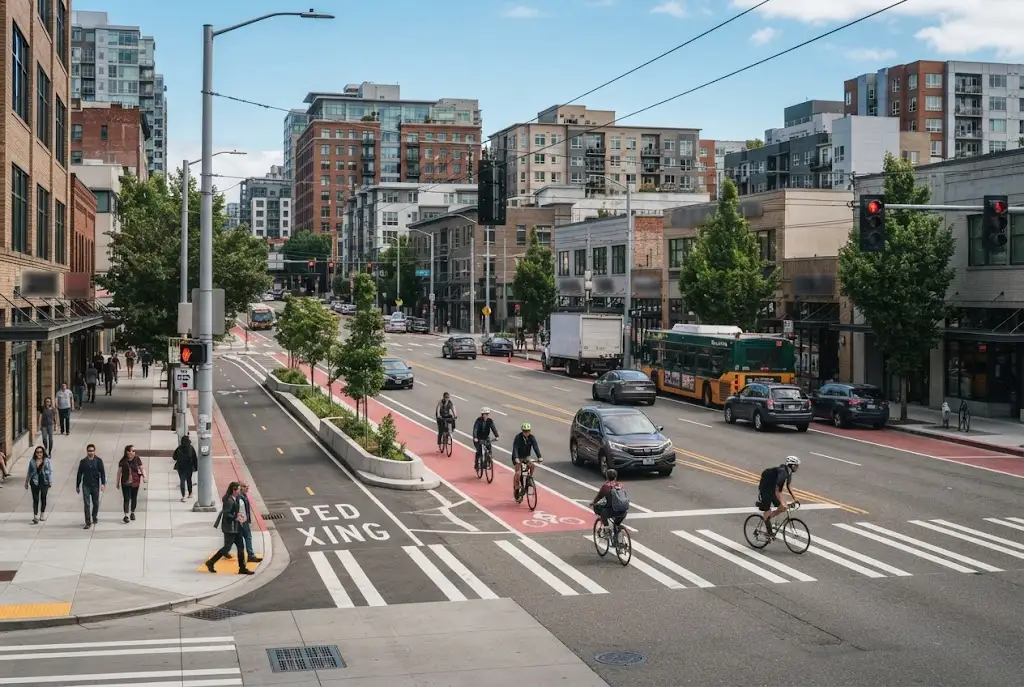
As metropolitan areas grow, roads have to serve more people, vehicles, pedestrians, cyclists, delivery services, and public transportation users. That makes road protection an important part of urban planning. A well-designed city road should not only move traffic efficiently but also reduce opportunities for serious crashes and make streets easier to navigate.
Metro cities can improve road safety by treating protection as a core design objective rather than an afterthought. Better intersections, clearer lane arrangements, safer pedestrian crossings, appropriate speeds, lighting, maintenance, and infrastructure for different road users can all contribute to a safer urban transportation network.
Why Road Protection Matters in Metro Cities
Urban roads are used by many different types of travelers at the same time. A single corridor may carry private vehicles, buses, cyclists, pedestrians, commercial vehicles, and emergency services.
This mixture creates more potential points of conflict than a road designed primarily for through traffic. A city therefore needs to consider not only vehicle movement but also visibility, crossing points, turning movements, roadside activity, and the needs of people walking or cycling.
The goal should be a road network that allows people to move efficiently while reducing the consequences of ordinary human mistakes.
Design Roads Around the People Who Use Them
Road planning should begin with an understanding of how a street is actually used. Downtown corridors, residential streets, commercial districts, school areas, and major arterial roads can have very different safety requirements.
For example, a high-speed traffic corridor may require different treatments from a neighborhood street where pedestrians frequently cross the road. Treating every street in exactly the same way can create unnecessary risks.
The Federal Highway Administration’s Complete Streets resources emphasize integrating safety for different road users into transportation planning and evaluating infrastructure needs across a multimodal network.
Improve Pedestrian Protection
Pedestrians are among the most exposed road users because they have little physical protection when interacting with motor vehicles. Metro cities should therefore make walking routes predictable, visible, and easy to understand.
Useful measures can include well-positioned crosswalks, pedestrian signals, adequate sidewalks, lighting, curb improvements, pedestrian refuge areas, and better visibility near intersections.
Crossings should also be designed around actual pedestrian movement instead of assuming that people will always use a distant crossing point. When routes are inconvenient or unclear, people may attempt crossings that planners did not anticipate.
Make Intersections Safer
Intersections deserve particular attention because several traffic movements occur in a relatively small space. Vehicles may turn while pedestrians cross, cyclists may travel alongside traffic, and drivers may have limited visibility.
Cities can examine intersection geometry, signal timing, crossing distances, turning movements, sight lines, and lane markings when identifying potential improvements.
Clear road markings and predictable traffic controls can also reduce uncertainty. Drivers should be able to understand where they need to stop, which lane they should use, and where other road users are likely to appear.
Control Speed Where People and Traffic Mix
Speed has an important relationship with road safety. A driver traveling at a lower speed generally has more time to recognize a developing conflict and respond. Lower speeds can also reduce the severity of a collision when a crash cannot be avoided.
Metro cities should therefore consider the surrounding environment when establishing and enforcing speed limits. Areas with heavy pedestrian activity, frequent crossings, schools, commercial activity, or bicycle traffic may require a different approach from roads designed for longer-distance vehicle travel.
Speed management can also involve physical design. Narrower lanes, traffic-calming treatments, appropriately designed intersections, and streetscape changes can influence how drivers perceive and use a road.
Build Better Protection for Cyclists
Cyclists need infrastructure that accounts for their vulnerability and their interaction with motor vehicles. Depending on the street, this can include dedicated bicycle lanes, protected facilities, clearer markings, safer intersection treatments, and improved visibility.
Bike infrastructure should not be treated as an isolated feature. It works best when it connects logically with other parts of the transportation network and gives cyclists predictable routes through intersections and busy corridors.
Cities also need to consider parked vehicles, loading zones, turning vehicles, and other obstacles that can place cyclists in conflict with moving traffic.
Use Lighting and Visibility Strategically
Good visibility is essential to road protection. Drivers need enough information to recognize pedestrians, cyclists, lane boundaries, signs, traffic signals, and potential hazards.
Street lighting can be particularly important around intersections, crossings, transit stops, sidewalks, and areas with significant nighttime activity. Vegetation, parked vehicles, roadside structures, and poorly positioned signs can also create visibility problems.
Instead of adding lighting without examining the surrounding design, cities should look at the entire visual environment and identify where road users may struggle to see one another.
Maintain Roads Before Small Problems Become Major Hazards
Road protection is not limited to new construction. Regular maintenance is equally important. Damaged pavement, faded markings, blocked drains, broken signs, malfunctioning signals, and damaged sidewalks can create avoidable hazards.
Maintenance teams should prioritize problems according to their potential effect on road users. A damaged surface in a busy pedestrian or bicycle corridor may require different attention from a minor defect on a lightly used road.
Drivers also benefit from properly maintained vehicles when navigating urban roads. Resources such as vehicle maintenance and auto care can provide additional context on keeping vehicles ready for everyday driving.
Separate Different Types of Traffic Where Practical
Not every road needs complete separation between different users, but metro cities should evaluate where separation can reduce conflict. Busy pedestrian corridors, bicycle routes, public transportation facilities, and major vehicle routes may require carefully planned spaces.
Commercial vehicles also need suitable loading and access arrangements. If delivery vehicles regularly stop in travel lanes or block bicycle and pedestrian facilities, the resulting conflicts can undermine an otherwise well-designed street.
This is particularly important in large metropolitan environments where transportation demand is high. The broader concept of mega-city development illustrates why transportation infrastructure needs to evolve alongside population and economic activity.
Design for Emergency Access
Road protection should also account for emergency vehicles. Fire trucks, ambulances, and police vehicles need reliable access through busy urban areas.
Street layouts, parking restrictions, traffic controls, and road construction projects should be evaluated to ensure emergency responders can reach their destinations without unnecessary obstacles.
Temporary road closures and construction zones deserve particular attention because they can change normal traffic patterns quickly. Clear detours, visible signs, and safe temporary routes can help reduce confusion.
Use Road Design to Encourage Safer Driving
Drivers respond to the environment around them. A wide, open road with few visual cues may encourage higher speeds, while a carefully designed urban street can communicate that drivers need to slow down and pay attention.
This does not mean making every road difficult to navigate. The objective is to create a clear relationship between road design and the function of the street.
The difference between urban and highway driving is useful to consider when evaluating vehicle behavior. A related discussion of city versus highway driving highlights how vehicle use and road conditions differ between environments.
Consider the Needs of Different Metro Areas
There is no universal road design that works equally well in every American city. Climate, street width, population density, terrain, development patterns, public transportation, and local travel behavior all influence transportation planning.
For example, the transportation environment in a dense coastal city may differ significantly from a sprawling Sun Belt metropolitan area. Readers exploring urban destinations such as Atlanta, Milwaukee, or Los Angeles can see how different city forms create different transportation environments.
Other metropolitan examples in the site’s city and travel coverage include the San Francisco Bay Area, Washington, DC, and San Diego. These examples should not be treated as identical road systems; they demonstrate why local context matters when considering urban transportation.
Account for Automobile Maintenance and Road Conditions
Safer streets also depend on vehicles being capable of operating properly. Worn tires, faulty lights, damaged brakes, or other mechanical problems can make it harder for drivers to respond to changing traffic conditions.
Metro residents can reduce avoidable problems by keeping vehicles maintained and addressing safety-related defects promptly. Local automotive resources such as Adams Village auto service and Ballietsville auto service show how vehicle maintenance fits into the wider transportation ecosystem.
For unusual vehicle use, the site’s coverage of a street-legal Humvee also illustrates why vehicle characteristics and road suitability should be considered together.
Use Data to Identify Dangerous Locations
Metro cities should not rely entirely on assumptions when deciding where road improvements are needed. Crash records, traffic volumes, pedestrian activity, bicycle use, speed observations, public feedback, and roadway conditions can help identify problem areas.
Data can reveal patterns that are difficult to recognize from occasional site visits. A location with repeated conflicts may require a design change rather than simply additional warnings.
Transportation agencies can then prioritize projects according to risk, available resources, and the needs of the surrounding community.
Plan Roads Around Future Growth
Road infrastructure can remain in place for decades, while the communities around it continue to change. Metro cities should therefore consider future development when planning major transportation projects.
New housing, commercial districts, schools, transit services, and employment centers can all change traffic patterns. A road that works adequately today may become overloaded or less suitable as surrounding development increases.
Urban growth can also influence travel demand beyond a single city. Regional connections between metropolitan areas, suburbs, and employment centers should be considered when transportation plans are developed.
Improve Safety Without Sacrificing Mobility
Road protection does not have to mean stopping efficient transportation. The strongest urban designs attempt to balance movement with safety.
That balance may involve clearer lane organization, better signal coordination, safer crossings, appropriate speed management, improved transit access, protected bicycle infrastructure, and targeted changes at locations with documented safety problems.
When improvements are based on how people actually use a street, cities can make transportation more predictable without unnecessarily restricting movement.
What Metro Cities Should Prioritize
A practical road-protection strategy can focus on several fundamentals:
- Design streets for pedestrians, cyclists, motorists, and transit users.
- Improve visibility at intersections and crossings.
- Manage speeds according to the surrounding environment.
- Maintain pavement, markings, signs, signals, and sidewalks.
- Use data to identify recurring safety problems.
- Provide reliable emergency access.
- Plan for delivery vehicles and commercial traffic.
- Consider future development and changing travel patterns.
- Connect walking and cycling infrastructure instead of treating it as isolated segments.
- Evaluate safety improvements after implementation and adjust them when necessary.
Frequently Asked Questions
What makes a metro city road safer?
Safer metro roads generally combine appropriate speeds, clear traffic controls, good visibility, well-designed intersections, pedestrian facilities, bicycle infrastructure, reliable maintenance, and road layouts that reflect how the street is actually used.
Why are intersections important for urban road safety?
Intersections bring together multiple traffic movements and road users. Clear signals, markings, crossing facilities, sight lines, and predictable turning arrangements can reduce conflicts and make movements easier to understand.
How can cities protect pedestrians on busy roads?
Cities can consider sidewalks, visible crossings, pedestrian signals, lighting, refuge areas, appropriate speeds, traffic-calming measures, and intersection designs that reduce unnecessary crossing distances.
Should every metro road have bicycle lanes?
Not necessarily. Bicycle facilities should reflect the type of street, traffic conditions, available space, network connections, and local travel patterns. The objective is to provide a safe and predictable way for cyclists to travel where cycling demand exists.
Does lower vehicle speed improve urban road safety?
Speed management is an important part of urban road safety because lower speeds can give road users more time to respond and can reduce injury severity when collisions occur. Road design, enforcement, and appropriate speed limits can work together.
Why is road maintenance part of protection?
Damaged pavement, faded markings, malfunctioning signals, poor lighting, and blocked drainage can create hazards. Regular inspection and maintenance help prevent small infrastructure problems from becoming larger safety concerns.
Conclusion
Metro cities should treat road protection as a fundamental part of urban development. Roads are more than channels for moving cars; they are shared public spaces used by pedestrians, cyclists, transit passengers, commercial vehicles, emergency responders, and drivers.
The most effective approach is to design streets around real-world conditions, manage speed, improve visibility, protect vulnerable road users, maintain infrastructure, and use data to identify where improvements are most needed.
As metropolitan areas continue to grow, transportation planning that places protection at the center can help cities create roads that are not only more efficient but also more predictable, accessible, and resilient for the people who depend on them.
For broader context on modern street safety and multimodal planning, the Federal Highway Administration’s Complete Streets resources provide planning and safety guidance for transportation professionals.