
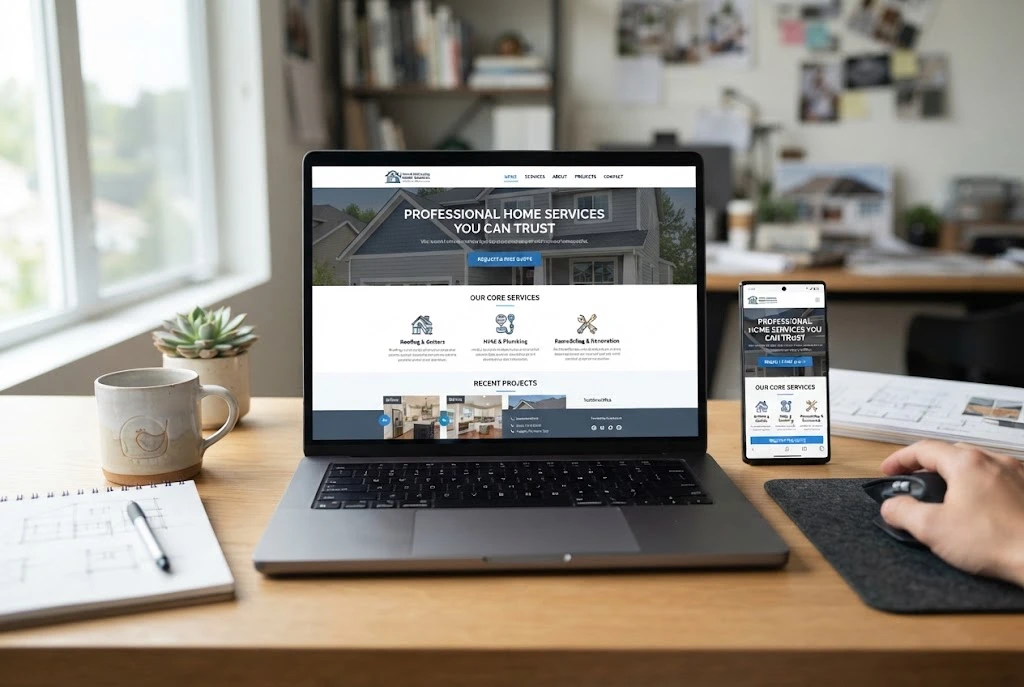
A strong website connects design, usability, local visibility, service information, credibility, and conversion opportunities into one clear customer journey. The goal is simple: when someone needs a service, your website should make it easy for that person to understand your offer and take the next step.
Why Home Services Website Design Matters
Home service customers often arrive with a specific problem. A homeowner may need an HVAC repair, electrical inspection, plumbing service, cleaning appointment, or home improvement project. They do not want to spend several minutes searching through a confusing website before finding an answer.
Your website functions as a digital storefront for your service business. It should immediately communicate three things: what you offer, where you operate, and how a customer can contact you.
For example, a business offering plumbing, electrical, and HVAC services can use separate service pages to explain each area of expertise. A company specializing in residential remodeling can organize its website around kitchens, bathrooms, additions, flooring, and other project types.
NatureUpdate’s existing C&C Home Services coverage provides another example of how individual home-service topics can support a broader service-focused content cluster.
What a High-Performing Home Services Website Should Include
The best home services websites are not necessarily the most complicated. They are the ones that make important information easy to find and important actions easy to complete.
1. A Clear Homepage
The homepage should quickly establish the company’s primary service, service area, and value proposition. Visitors should not have to scroll through several sections before understanding what the business actually does.
A useful homepage typically includes a clear headline, short supporting copy, primary call-to-action, key services, trust signals, project or service imagery, customer feedback, and convenient contact options.
2. Dedicated Service Pages
Do not place every service into one large paragraph. Give important services their own pages whenever there is enough useful information to justify them.
A dedicated service page can explain the problem the service solves, what customers can expect, common questions, the service process, relevant qualifications, and the next step for requesting assistance.
This structure also gives search engines clearer topical signals and creates more opportunities to match specific searches with relevant pages.
3. Strong Calls to Action
A website should tell visitors what to do next. Depending on the business, that action could be calling the office, requesting an estimate, scheduling an appointment, submitting a service form, or asking for more information.
Use clear language rather than vague buttons. A phrase such as Request a Service Estimate communicates more than a generic button labeled Submit.
4. Mobile-Friendly Design
Home service customers frequently search while dealing with an immediate household problem. They may be using a phone rather than sitting at a desktop computer. Your website therefore needs a responsive layout with readable text, accessible navigation, properly sized buttons, and forms that are comfortable to complete on smaller screens.
Phone numbers should be easy to find, particularly for services where customers may need urgent assistance.
5. Trust-Building Elements
Hiring someone to work inside a home requires trust. Your website should help visitors understand why they should feel comfortable contacting your company.
Depending on the business, useful trust elements can include genuine customer reviews, project photographs, years in business when accurate, licensing information, insurance information, professional memberships, warranties, service guarantees, and clearly presented contact details.
Only display certifications, licenses, guarantees, or claims that your business can actually substantiate.
Design Your Website Around Customer Intent
Good home services website design begins with understanding what visitors are trying to accomplish.
Someone searching for emergency plumbing help has a different intent from someone researching a planned bathroom renovation. The first visitor may need an immediate phone number and service availability. The second may want project examples, process information, estimated considerations, and a way to schedule a consultation.
Your website should accommodate these different journeys rather than forcing every visitor through the same page.
Match Pages to Specific Problems
Instead of creating a page that simply says your company provides home services, develop useful pages around actual customer needs. Plumbing repair, drain cleaning, water heater service, electrical troubleshooting, HVAC maintenance, home cleaning, landscaping, and remodeling can all require different information.
This approach also makes the site easier to expand as the business grows.
Local SEO Should Be Part of the Design
Website design and SEO should not be treated as completely separate projects. The structure of a home service website affects how visitors navigate it and how search engines understand its content.
Important pages should have descriptive titles, useful headings, readable content, meaningful URLs, optimized images, and logical internal links.
Location information should also be handled carefully. If a business genuinely serves several communities, its website can explain those service areas where appropriate. Avoid creating thin location pages that provide little useful information simply to target additional city names.
Content about digital marketing can also complement a service-business website strategy. NatureUpdate’s digital marketing and business services coverage can be considered part of the broader relationship between online visibility and business growth.
Build an Internal Linking Structure
Internal links help visitors discover related information while giving your website a clearer topical structure. A home services website can connect its main service pages with supporting resources, related service information, maintenance guides, and business-focused content.
For example, a website discussing HVAC-related services can connect relevant service information with articles about air-conditioning repair services and local air-conditioning repair topics.
Internal links should be placed where they genuinely help the reader. Avoid adding links simply to increase the number of links on a page.
Use Visuals That Demonstrate Real Work
Home service businesses have a major advantage when it comes to visual content: their work can often be demonstrated.
Use authentic photographs of completed projects, technicians performing relevant work, equipment, before-and-after results, installations, renovations, or other appropriate activities. These visuals can help visitors understand the quality and scope of the service.
Images should also be optimized for performance. Use descriptive filenames, appropriate dimensions, modern formats such as WebP where supported, and useful alternative text.
A website should look professional without becoming visually heavy. Decorative animations, oversized videos, excessive sliders, and unnecessary effects can distract visitors and add technical weight without improving the customer journey.
Website Speed and Technical Performance
Performance matters because customers are unlikely to appreciate a beautiful website that takes too long to become usable.
Image compression, efficient code, caching, lightweight page components, and sensible media usage can all contribute to a faster experience. Large background videos and unoptimized images deserve particular attention because they can add unnecessary page weight.
Performance should be considered during the design stage rather than treated as a problem to solve after the website has already been built.
Technical topics can also be connected to the broader technology content available on NatureUpdate, including modern technology solutions and technology and business infrastructure.
Make Contacting the Business Easy
A home service website should remove unnecessary friction from the contact process.
Keep important contact information consistent and easy to locate. Depending on the business model, useful options may include a click-to-call phone number, quote request form, appointment request, email address, service inquiry form, or online scheduling system.
Forms should request only information that is genuinely necessary at the first stage. A long form can discourage visitors who simply want to explain a problem and begin a conversation.
If the business has an office team responsible for answering inquiries, the website should also set realistic expectations about how customers can receive assistance.
Use Reviews and Project Evidence Carefully
Customer feedback can help establish credibility, but it should be presented honestly. Use genuine reviews rather than generic claims about being the best company in the area.
Project portfolios can be even more useful for businesses such as remodelers, landscapers, painters, cleaners, and contractors. Organize projects by service type where appropriate and provide enough context for visitors to understand what was completed.
Related home-service content can strengthen this broader subject area. For example, visitors researching home service providers may also encounter NatureUpdate’s Tucker Home Services coverage or its Rightime Home Services coverage.
Design for Conversion Without Making the Site Feel Aggressive
Conversion-focused design does not mean filling every section with sales messages. It means giving visitors a logical path toward an action that makes sense.
A strong page might begin with the service and problem being addressed, explain the benefits, demonstrate credibility, answer common questions, show relevant work, and finish with a clear contact option.
Use calls to action at natural points rather than repeating the same promotional message after every paragraph.
Content Should Support the Website, Not Compete With It
A home service business can use educational content to answer customer questions before they make contact. Helpful articles can cover maintenance, preparation, common problems, project planning, service expectations, and other topics related to the company’s actual expertise.
The goal is not to publish hundreds of generic posts. A smaller collection of useful resources that genuinely support customers can create a stronger topical structure.
Businesses interested in broader marketing strategy can also explore NatureUpdate’s digital marketing strategy content and digital marketing business strategy coverage.
Common Home Services Website Design Mistakes
- Too much information above the fold: Visitors should understand the core offer quickly.
- Weak contact options: Customers should not have to search for a phone number or inquiry form.
- One page for every service: Important services often deserve focused pages.
- Stock photography everywhere: Authentic project imagery can communicate credibility more effectively.
- Slow media: Large images, videos, and scripts should be optimized.
- Unclear service areas: Visitors should understand where the company actually operates.
- Unsupported claims: Avoid unverified awards, certifications, guarantees, or performance statements.
- Poor mobile experience: Navigation, buttons, forms, and contact information should work comfortably on phones.
- Weak internal linking: Related service and educational pages should be connected where useful.
- Overly generic copy: Website content should explain the actual services, process, and customer benefits.
How to Plan a Home Services Website Redesign
If an existing website is underperforming, start with an audit rather than immediately choosing a new visual theme.
- Identify the services that generate the most business value.
- Review the current navigation and page structure.
- Identify pages with weak or outdated content.
- Check the mobile experience.
- Review contact forms and calls to action.
- Evaluate page speed and image optimization.
- Map important services to dedicated pages.
- Connect related pages with contextual internal links.
- Add genuine trust and project evidence.
- Measure leads and user behavior after improvements.
This process creates a stronger foundation than redesigning the homepage alone.
Related Home Service and Business Topics
NatureUpdate’s sitemap includes additional home-service, technology, business, and digital-marketing topics that can support a broader content cluster. Relevant examples include automotive service content, business logistics coverage, digital marketing ROI content, digital marketing strategy content, and digital marketing and business performance coverage.
These connections can be useful when building a broader business-focused information architecture without forcing unrelated topics into the same page.
Frequently Asked Questions
What is home services website design?
Home services website design is the process of creating a website specifically for businesses that provide services at residential or commercial properties. It combines visual design, usability, service information, SEO, trust elements, and conversion-focused functionality.
What should a home services website include?
Important elements usually include clear service information, dedicated service pages, contact options, strong calls to action, mobile responsiveness, genuine reviews, project imagery, service-area information, and useful supporting content.
Why are dedicated service pages important?
Dedicated service pages allow a business to explain individual services in greater detail and create clearer pathways for customers searching for specific solutions.
How can a home services website generate more leads?
A website can support lead generation by making services easy to understand, demonstrating credibility, addressing customer questions, providing clear calls to action, and simplifying phone, quote, appointment, or inquiry requests.
Should a home services website be mobile-friendly?
Yes. Responsive design helps ensure that navigation, content, forms, buttons, and contact information remain usable across smartphones, tablets, and desktop screens.
How does SEO fit into website design?
SEO can be incorporated through logical site architecture, descriptive page content, useful headings, optimized images, internal linking, relevant service pages, and technically accessible pages.
Conclusion
Effective home services website design is built around the customer rather than decoration alone. A successful site explains the business clearly, presents services in an organized structure, establishes credibility, performs well across devices, supports search visibility, and gives visitors an easy path to contact the company.
For home service businesses, the website should work as part of a larger digital system. Service pages, educational content, internal links, visual proof, local information, technical performance, and conversion opportunities should all support the same objective: helping the right customer understand the service and take the next appropriate step.
When design and useful content work together, a home services website becomes more than an online brochure. It becomes a practical digital hub for visibility, education, trust, and customer inquiries.


